
Knee
Fat–Fluid Leveling in Acute Knee Trauma: A Critical Red Flag for Intra-Articular Fracture
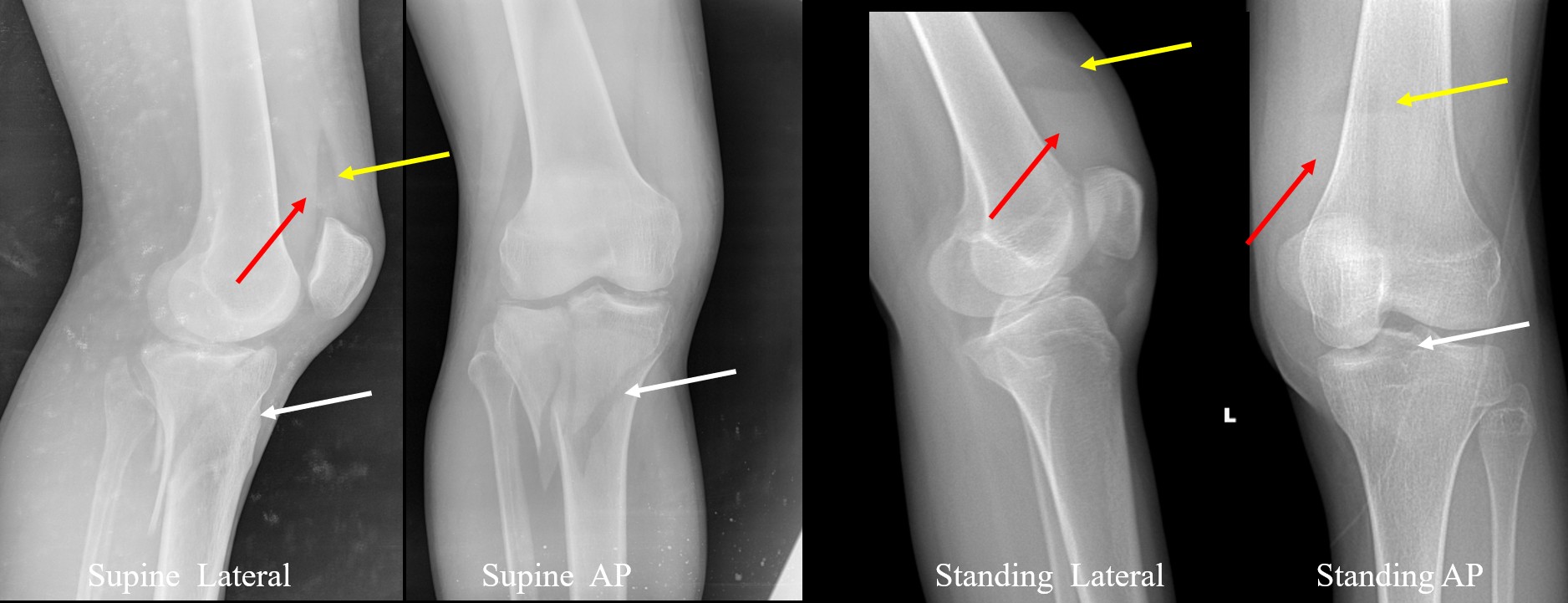
Definition
Lipohemarthrosis refers to the presence of fat and blood within the joint space, resulting in a fat–fluid level due to density differences.
It is a strong indirect radiographic sign of an intra-articular fracture, even when no fracture line is visible.
Imaging Findings
- Standing lateral knee radiographs
- Best projection for demonstrating fat–fluid leveling
- Sensitivity reported up to ~95%
- Standing AP radiographs
- Fat–fluid level may also be visible
- Fat–fluid leveling is usually not detected
- Required in non-ambulatory patients
- Leveling is seen only on the lateral view
- Supine AP radiographs
- Supine cross-table lateral
⚙️ Pathophysiology
Following an intra-articular fracture:
- Fat from bone marrow rises to the non-dependent (lucent) portion
- Blood settles in the dependent (opaque) portion
- Upright positioning enhances gravitational separation, improving detectability
Key Teaching Points
- A visible fat–fluid level should prompt strong suspicion of an intra-articular fracture
- Absence of a fracture line does not exclude fracture
- Standing radiographs, when feasible, reduce the risk of missed occult fractures
- In non-ambulatory patients, true cross-table lateral imaging is mandatory
Take-home Message
- Fat–fluid leveling due to lipohemarthrosis is a red flag for intra-articular knee fractures.
Whenever possible, obtain standing knee radiographs to avoid missed diagnoses.


· · European Radiology
The utility of standing knee radiographs for detection of lipohemarthrosis
https://link.springer.com/article/10.1007/s00330-023-10163-8
· Clinical Radiology
Fat–fluid level on standing lateral knee radiographs as a reliable indicator of occult fractures
https://www.clinicalradiologyonline.net/article/S0009-9260(25)00391-5/fulltext

0 COMMENTS
These issues are no comments yet. Write the first comment...